How to Style a Kasbah Garden Morning Corner with Tamegroute Green & Natural Wood

Style at a Glance
Vibe: Sun-drenched courtyard garden meets organic minimalism
Color Palette: Tamegroute green, sun-bleached straw, honey-toned lemon wood
Hero Product: Handwoven Palm Leaf Bar Chair with basket-weave backrest and solid lemon wood frame
There’s a particular quality of light that only exists in a walled garden at 8 a.m., when the sun is still low enough to cast long shadows through date palms and the air smells faintly of wet earth and mint. This is the moment we’re bottling with this collection: raw, breathing materials that feel like they’ve always belonged together. Tamegroute’s signature reactive green glaze against the pale whisper of handwoven straw. Natural wood worn smooth by artisan hands. Not styled. Simply placed.
The Anchor: Handwoven Palm Leaf Chair That Grounds the Space
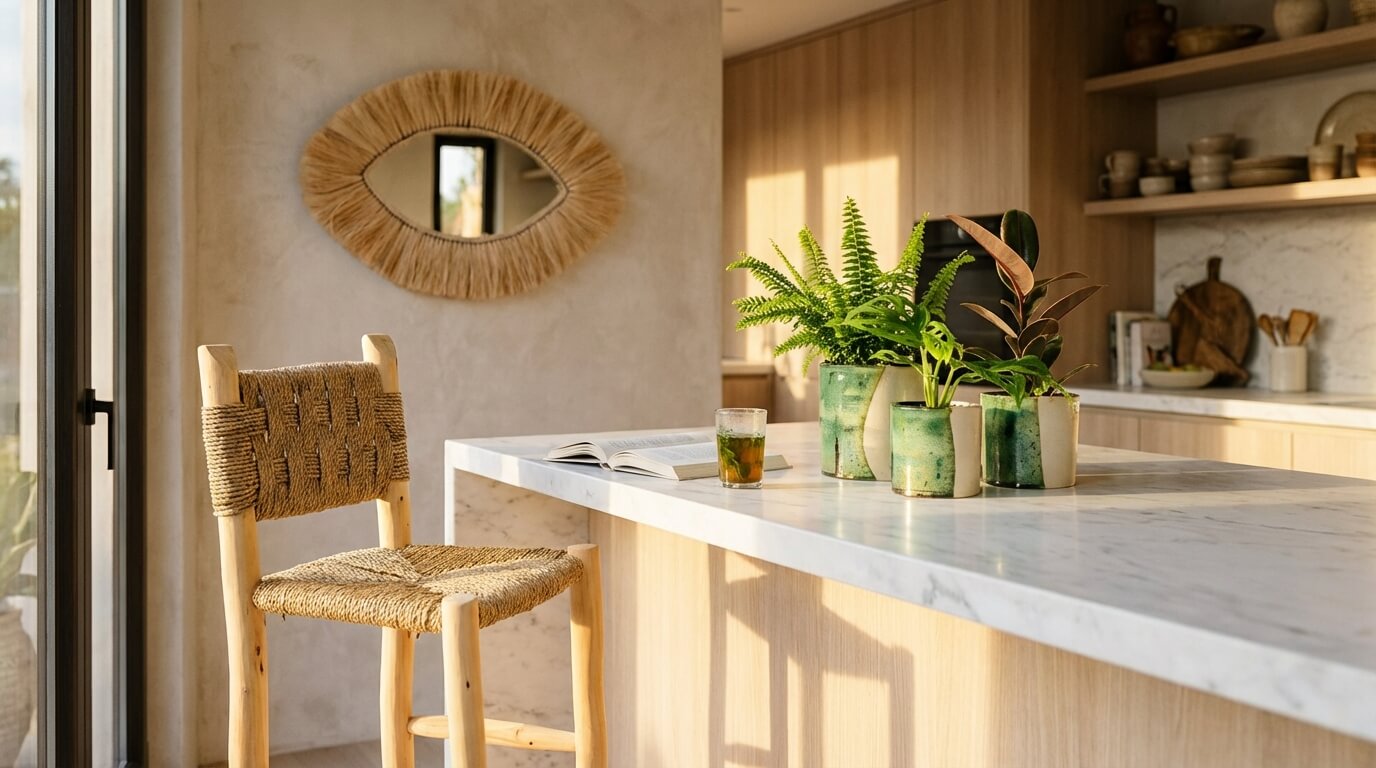
The Handwoven Palm Leaf Bar Chair is your foundation piece, and it earns that role through sheer material honesty. Solid lemon wood—not painted, not stained—joined with traditional mortise-and-tenon joinery you can actually see. The backrest is a work of patient hands: palm fiber woven in a basket pattern tight enough to support your spine, open enough to let light through.
Position this chair where morning light will hit it directly. The honey-colored wood will warm to amber, and those woven palm fibers will cast delicate grid shadows on your floor. Use it as a counter-height perch in a kitchen with a garden view, or pair two flanking a narrow console in an entryway. The seat height (24 inches for counter, 30 for bar) makes it ideal for lingering—morning coffee, evening aperitifs, the kind of conversations that stretch longer than planned.
The palm weaving will develop character over time. This isn’t a flaw. It’s a feature of working with living materials that remember where they came from.
Supporting Act: Tamegroute Planters That Breathe Life Into Corners
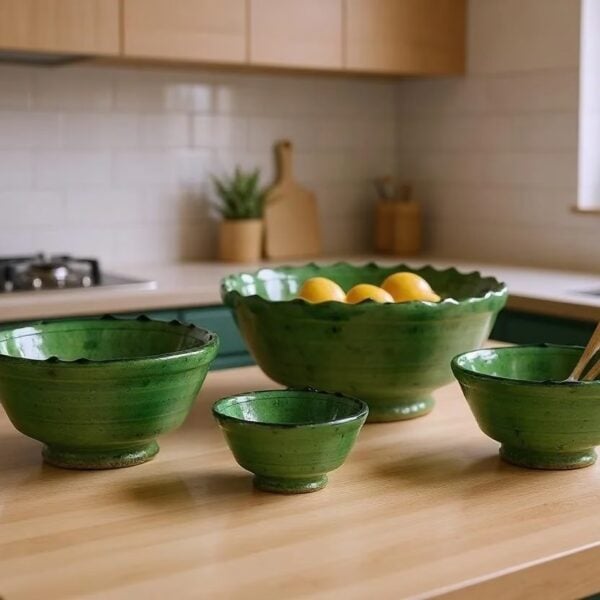
Now bring in the green. The Tamegroute Ceramic Plant Pots are what happens when mineral-rich glaze meets an open flame and centuries-old kilns in southern Morocco. That distinctive green—somewhere between oxidized copper and deep forest moss—is never uniform. Each pot carries organic drips, darker pools where glaze collected, lighter halos where the flame kissed hardest.
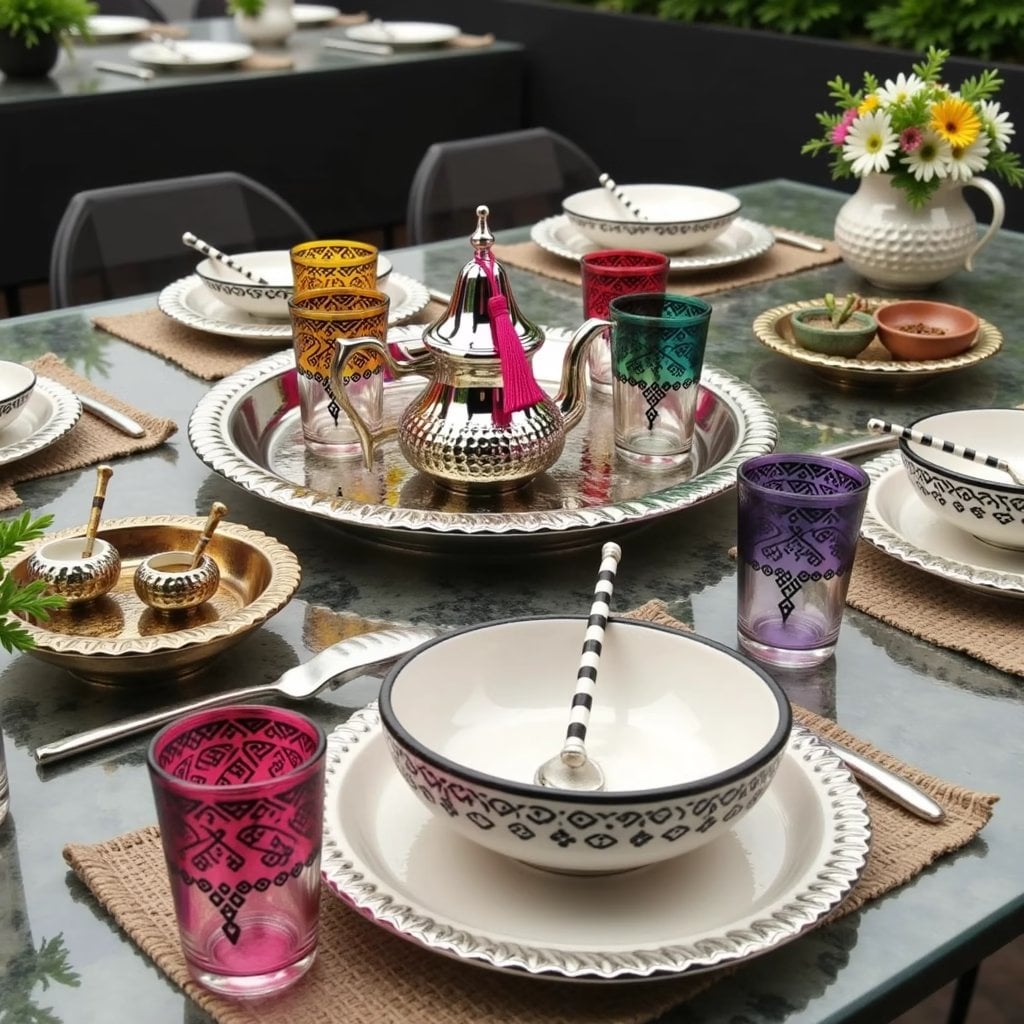
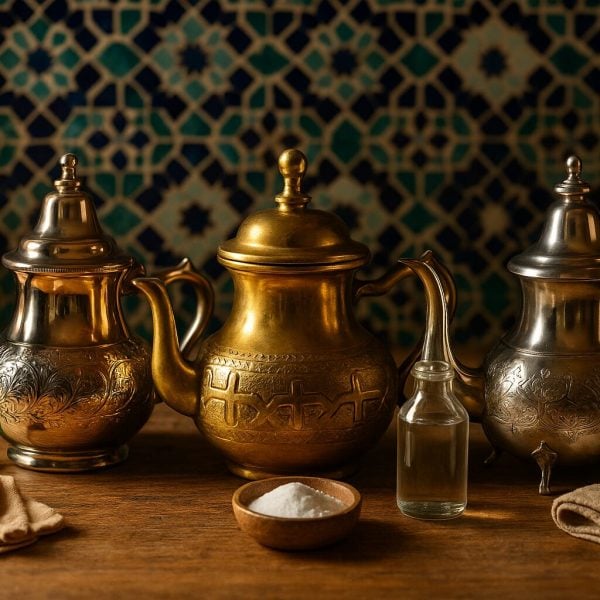
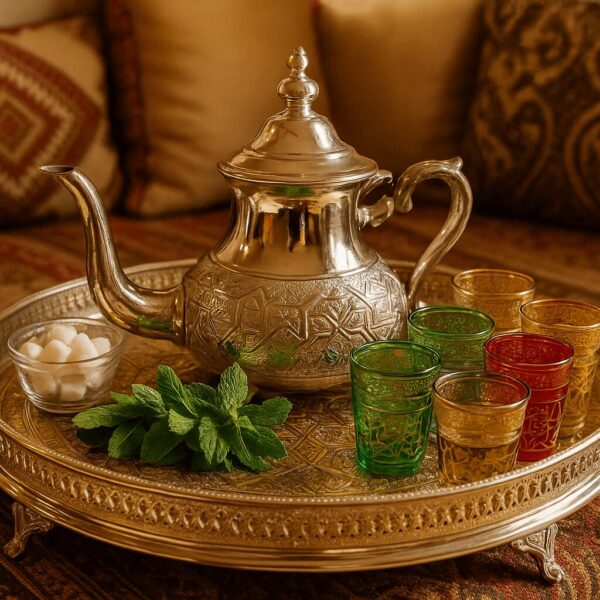
Cluster all three sizes on a low wooden stool or side table within arm’s reach of your palm chair. Fill the largest with a mature fern whose fronds will arch over the pot’s rim. The medium pot takes a snake plant or small fiddle leaf fig. The smallest is perfect for trailing pothos or herbs you’ll actually use — basil, mint, thyme cut fresh for a morning cup served in a Moroccan tea set placed on the bar beside your palm chair.
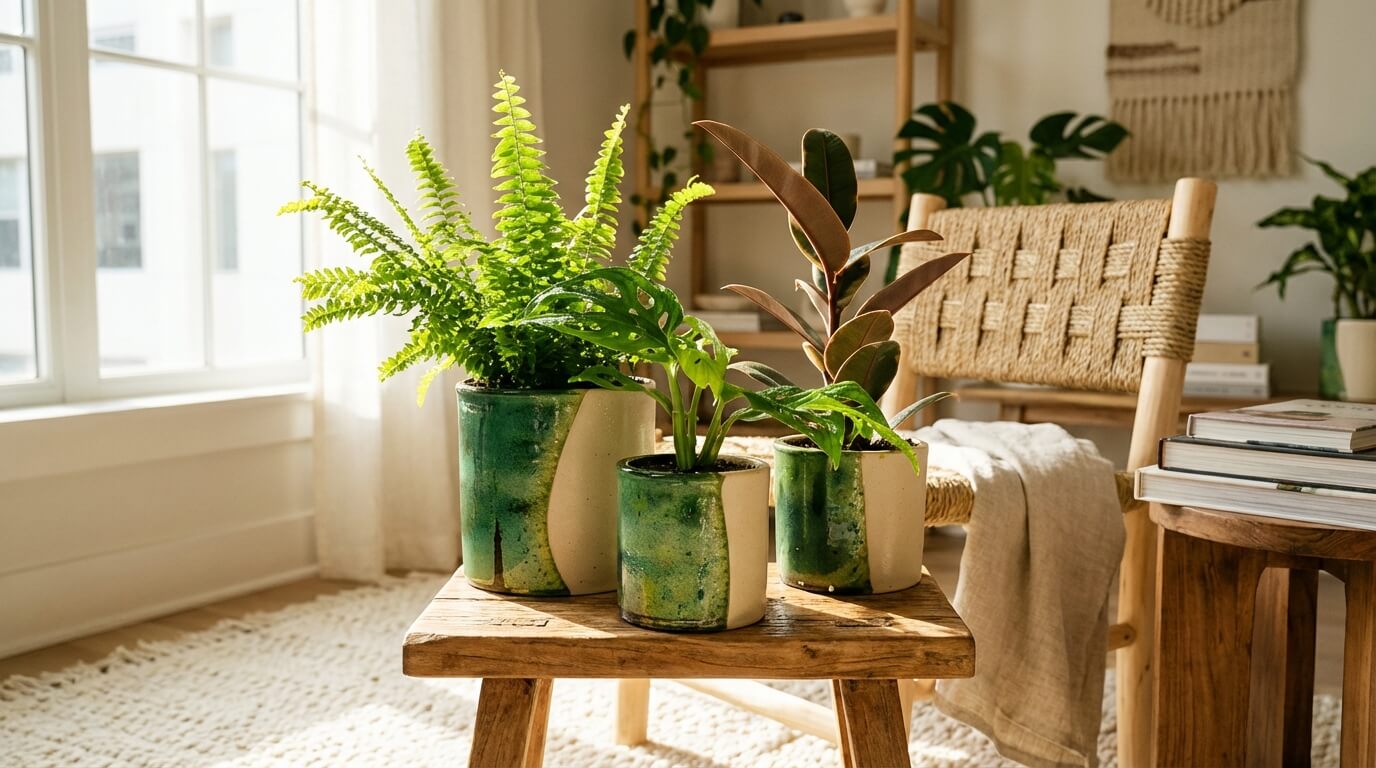
The reactive glaze means these planters shift appearance throughout the day. Morning light makes the green sing bright and vital. Late afternoon sun deepens it to near-black in the shadows, jewel-bright where light hits directly. Place them where they’ll catch shifting natural light, not static overhead fixtures.
The Finishing Touch: A Straw Mirror That Multiplies Light
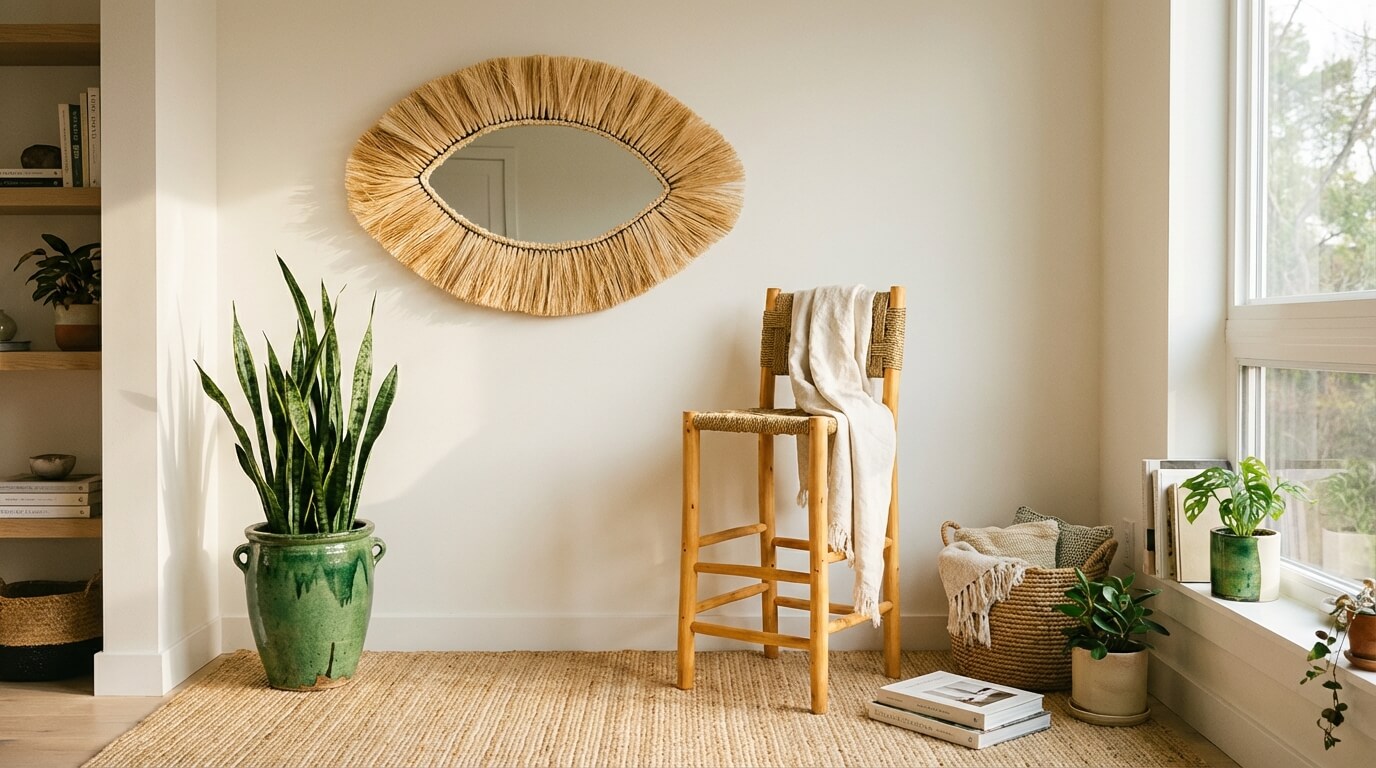
The Handwoven Straw Eye Mirror is your final layer, and it does two jobs at once. First, it reflects and bounces whatever morning light you’ve got, making small spaces feel airier. Second, that distinctive eye shape—20 inches of tightly coiled natural straw forming an almond silhouette—adds a sculptural focal point that doesn’t scream for attention.
Hang it 58 inches from the floor (center of the mirror to ground) on the wall opposite a window if possible. This creates a cross-conversation of light: natural rays come in, hit the mirror, scatter back across your palm chair and green planters. The sun-bleached straw color—that perfect gradient from cream to pale gold—acts as a neutral bridge between the warmer lemon wood and cooler Tamegroute green.
The handwoven construction means you’ll see slight variations in the coil tightness, small ridges where one strand ended and another began. These aren’t imperfections. They’re proof a human sat with this material and shaped it with intention, the same way artisans have done in Moroccan cooperatives for generations.
Styling Rules for a Kasbah Garden Corner
- Layer heights in odd numbers: Place your tallest planter (12 inches) on the floor, medium (9 inches) on a 6-inch wooden riser, smallest (7 inches) directly on your counter or table. Creates visual rhythm without symmetry.
- Keep a 16-18 inch buffer zone: Position your palm chair this distance from the nearest wall or furniture edge. Allows the woven backrest to be appreciated from all angles and prevents the space from feeling cramped.
- Embrace negative space: Don’t fill every surface. Let the materials breathe. One corner well-styled beats three corners cluttered.
- Add texture underfoot: A flat-weave wool rug in cream or undyed natural fiber grounds the look. Avoid high-pile—it competes with the palm weaving rather than complementing it.
- Control your light temperature: If you’re supplementing natural light, use warm white bulbs (2700-3000K). Cool daylight bulbs will make the green planters look murky and drain warmth from the wood.
Building a Room Around Natural Materials
This trio works because each piece comes from the earth and shows its origins honestly. The lemon wood wasn’t chosen to match a paint chip—it simply is the color of lemon wood, with all the natural variation that implies. The Tamegroute glaze wasn’t formulated in a lab; it’s the result of specific minerals in southern Morocco’s clay reacting to specific kiln temperatures.
When styling with this level of material authenticity, your job isn’t to coordinate colors in the traditional sense. It’s to curate textures and let natural affinities reveal themselves. Rough straw plays beautifully against smooth ceramic. Woven palm has an innate conversation with coiled straw—they speak the same plant-fiber language. The green glaze adds the only saturated color, which makes it sing louder without overwhelming.
This approach aligns perfectly with the principles found in Moroccan style interior design—the layering of artisan-made objects, the respect for natural materials, the understanding that a room should feel collected over time rather than ordered in one click.
For a complete garden-morning experience, style a nearby surface with the ritual objects of a slow breakfast: a brass tray, small glass cups, perhaps a bowl of dates or fresh almonds. The goal is to create a corner that invites you to pause, not rush through.
Featured Products
- Handwoven Palm Leaf Bar Chair – Artisanal Lemon Wood Counter Stool
- Tamegroute Ceramic Plant Pots – Handmade Moroccan Pottery with Reactive Glaze
- Handwoven Straw Eye Mirror – Bohemian Wall Decor 20″
The Artisan Heritage
Every piece in this collection carries the mark of maker’s hands: palm fiber stripped and woven by cooperatives in Morocco’s southern villages, Tamegroute clay shaped and fired in wood-burning kilns using techniques passed through families for seven generations, straw coiled in tight spirals by artisans like Dounia, our straw weaver from Marrakech, who learned the craft as a child in her mother’s workshop. When you bring these objects home, you’re not just buying decor — you’re preserving craft traditions that exist outside factory timelines. Extend the Sahara palette further with a handwoven straw pouf underfoot and a straw pendant lamp overhead — the same palm-leaf craft, different forms. Meet the artisans behind these pieces, or explore our complete collection of Moroccan handicrafts to continue building your authentic, artisan-made home.