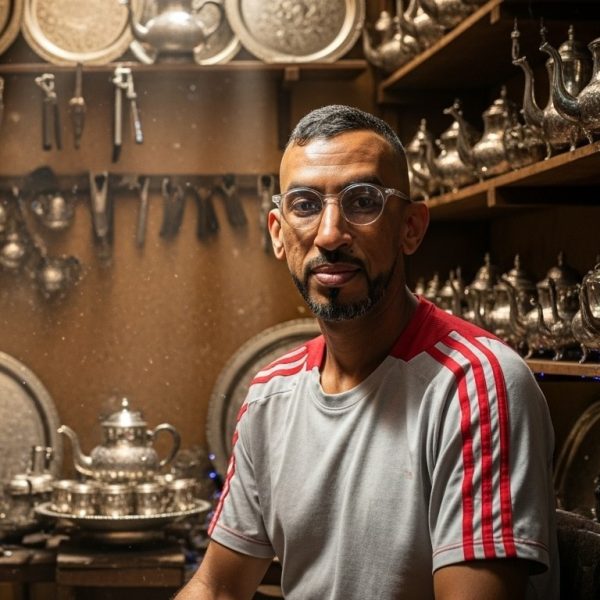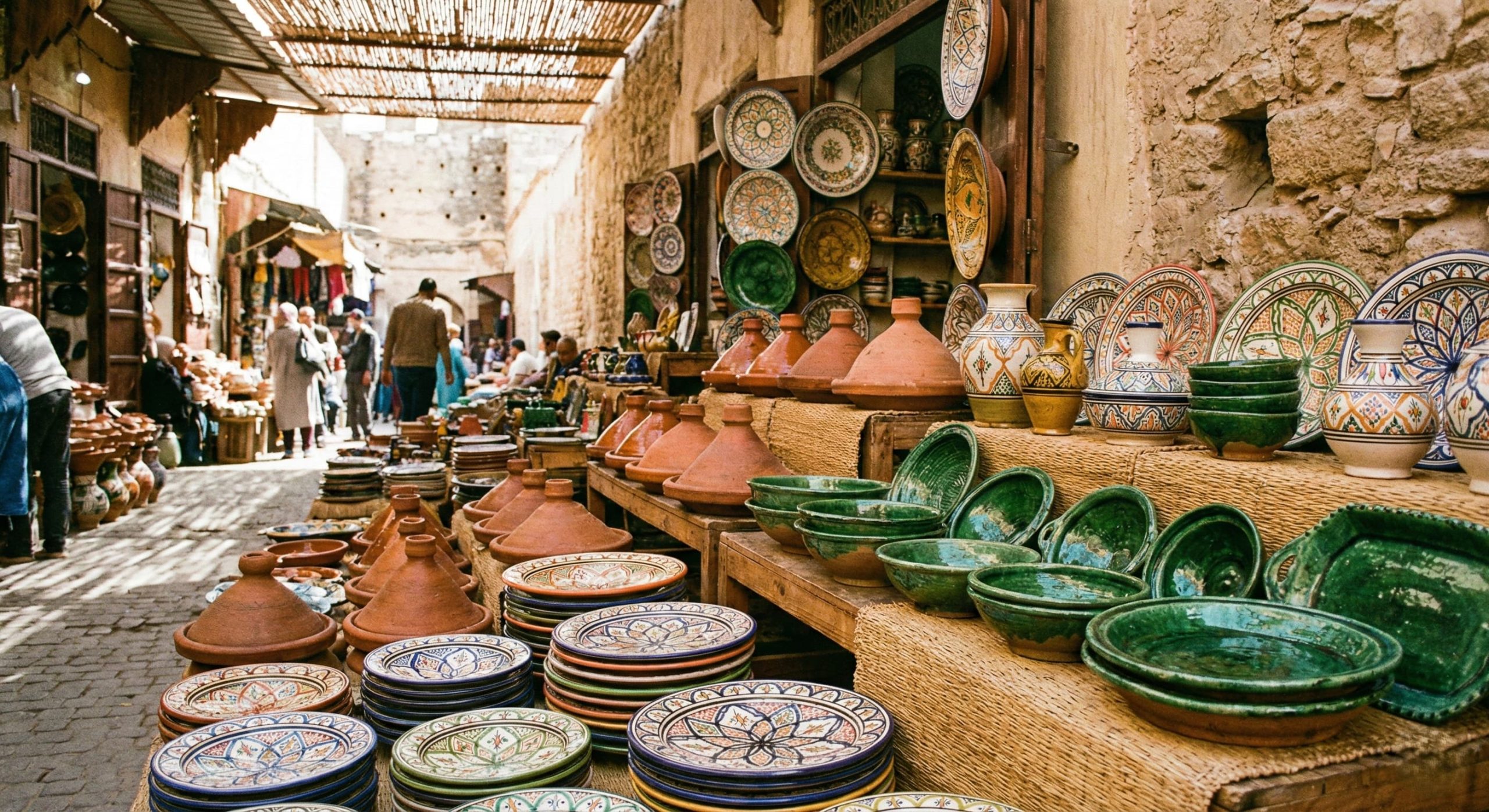
Moroccan pottery refers to handcrafted ceramic ware produced in Morocco using clay-forming, glazing, and hand-painting techniques passed down across generations of artisan families. It includes tableware, decorative vessels, tagines, and architectural tiles — each piece shaped and painted by hand, making every item genuinely one of a kind. The tradition spans more than twelve centuries and encompasses at least three distinct regional styles, each immediately recognizable by its color, clay body, and decoration — carried today by craftsmen like Jamal, our Marrakech ceramic artisan, who hand-paints every piece in his medina workshop.
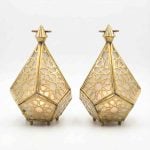
Understanding those regional differences is the key to buying and styling Moroccan ceramics with intention. For maximum visual impact, display pieces under a Moroccan brass pendant lamp — the warm light deepens glazed colours dramatically. This guide covers everything: the three pottery capitals, the main vessel types, how pieces are made, the food safety question buyers most often get wrong, and how to bring it all together at home.
Morocco’s Three Pottery Capitals
Moroccan ceramics is not a single unified aesthetic. It is a family of regional traditions shaped by local clay, local history, and centuries of unbroken craft lineage. The three centers every buyer should know are Fez, Safi, and Tamegroute — and the differences between them run deeper than color.
Fez — Cobalt Blue and Arabesque Precision
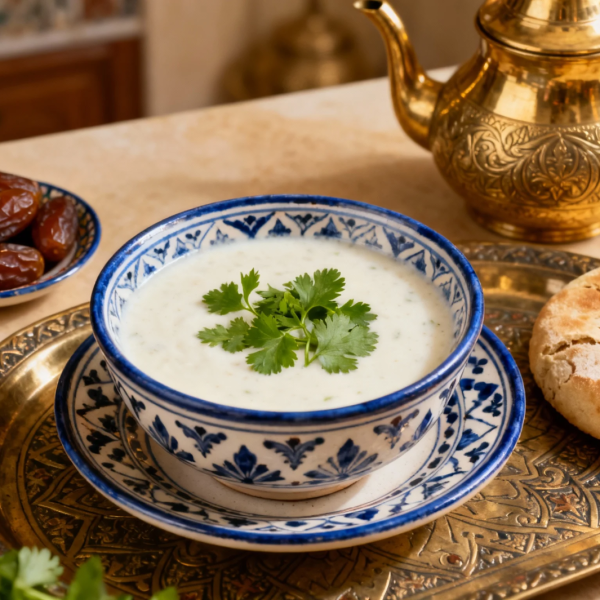
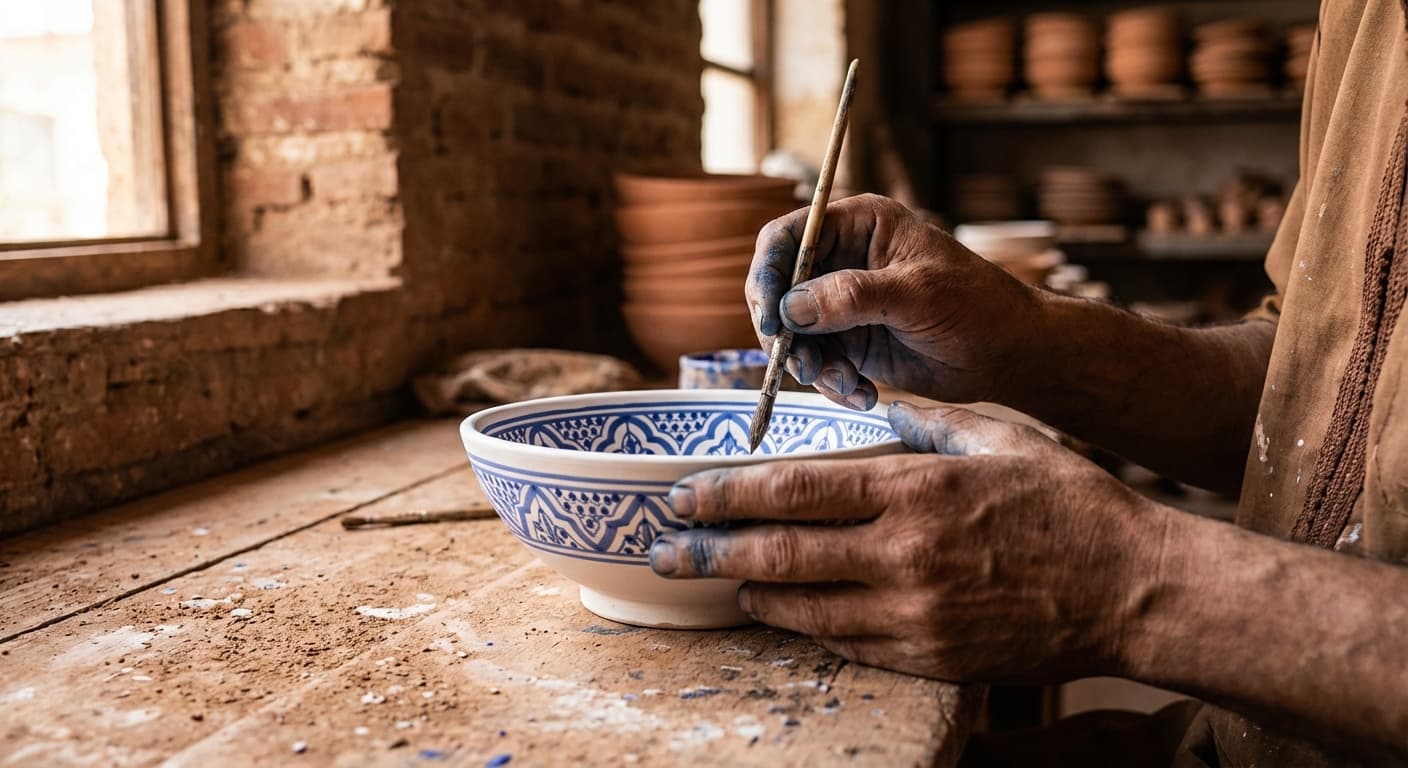
Fez is Morocco’s oldest pottery capital and the origin of what collectors call Fassi blue — the cobalt blue and white palette that has defined the city’s ceramics since the 12th century. Fez pottery is double-fired: raw clay is shaped and fired first, coated with a white tin-oxide glaze, then hand-painted with cobalt oxide pigment before a second firing fuses the decoration permanently into the surface. The result is precise, deeply saturated, and extraordinarily durable. The geometric interlace and arabesque patterns follow mathematical principles derived from Islamic geometric art — designs still learned through multi-year apprenticeship in the workshops of Fez’s Ain Nokbi pottery district. Fassi blue pieces are the most internationally recognized form of Moroccan ceramics and anchor any pottery collection.
Safi — Multicolor Vibrancy and Metal Inlay
Safi, on Morocco’s Atlantic coast, is the country’s largest pottery production center. Its artisans work with a mineral-rich red clay that produces a warm, deep base tone, decorated with a wide palette of greens, turquoise, black, and ochre. What makes Safi uniquely distinctive is a regional technique found nowhere else: thin sheets of hammered metal are inlaid into fired clay surfaces to add a reflective dimension to geometric patterns. The city’s Quartier des Potiers — the Potters’ Quarter — remains an active, working neighborhood where the entire production cycle happens within a few city blocks. Most of the green zellige tiles seen on Moroccan mosque rooftops originate here. Safi ceramics suit spaces that call for warmth, eclecticism, and depth of color.
Tamegroute — Green Glaze of the Drâa Valley
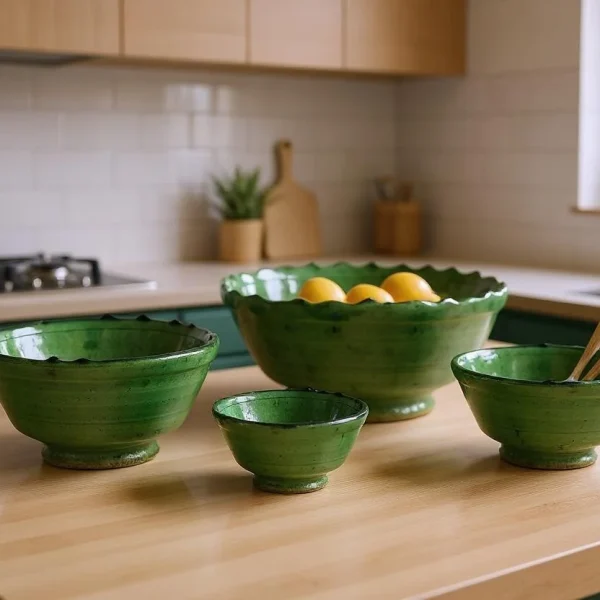
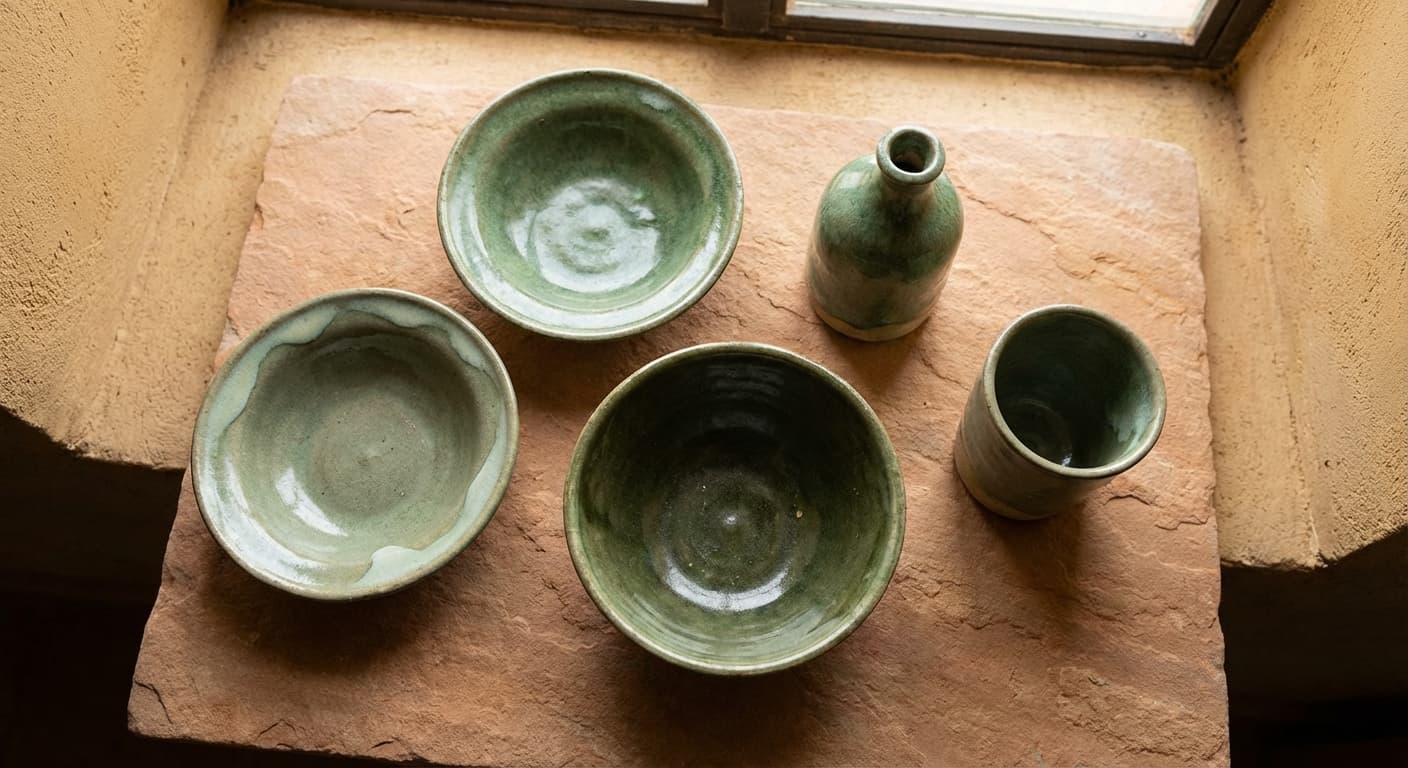
Tamegroute is a small oasis village near Zagora in the deep south of Morocco, and it produces arguably the most immediately recognizable pottery in the country. Its khzaf akhdar — green pottery — gets its color from a manganese and copper oxide glaze that flows unevenly during firing, producing a range from sage and moss to deep olive green that shifts from piece to piece. That variation is intentional: Tamegroute potters consider the natural movement of the glaze a mark of authenticity, not imperfection. The tradition has been tied for centuries to the village’s Sufi zaouia, a religious school whose charitable work was historically funded by pottery sales. Each piece carries both a visual story and a social one. For the full production process and the cooperative that protects it today, read our complete Tamegroute pottery guide.
Regional Comparison at a Glance
| Region | Signature Color | Clay Type | Defining Technique | Best For |
|---|---|---|---|---|
| Fez | Cobalt blue & white | Local red clay, tin-glazed white | Double-firing, freehand arabesque | Classic, formal interiors |
| Safi | Multicolor — green, turquoise, ochre | Mineral-rich Atlantic red clay | Metal inlay, wide palette glazing | Eclectic, warm, boho spaces |
| Tamegroute | Flowing sage to olive green | Deep-dug desert clay + local sand | Single copper/manganese glaze, natural variation | Organic, minimal, contemporary |
The Main Types of Moroccan Pottery
Across all three regional traditions, Moroccan potters produce a consistent repertoire of forms — each with its own function and its own decorative language.
Tagines
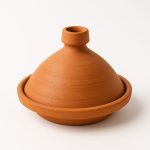
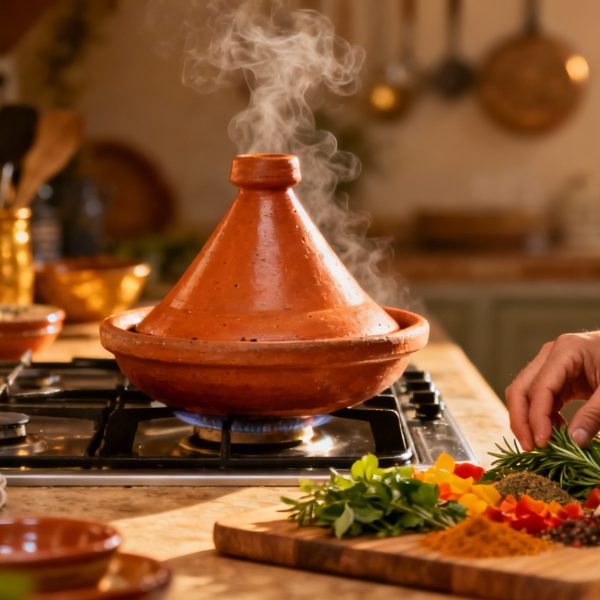
The conical-lidded cooking vessel synonymous with Moroccan cuisine. Cooking tagines are made from unglazed or lightly glazed terracotta that distributes heat gently and traps condensation, returning moisture to the dish throughout a slow cook. The clay itself is part of the flavor. Decorative tagines — the painted, highly glazed versions commonly sold in souks — are for display only (more on this in the food safety section below). If you want to cook with one, the science behind why slow cooking in clay produces better results is worth understanding before you buy.
Beldi Serving Bowls and Plates
Beldi — meaning traditional or authentic in Moroccan Arabic — describes the wide-rimmed, hand-thrown ceramic serving bowls and plates used daily in Moroccan homes for couscous, salads, and mezze. Earthy tones dominate: terracotta, cream, Tamegroute green, Fassi blue. The slight irregularity of beldi ware — walls that aren’t perfectly even, glaze that pools slightly at the base — is what distinguishes handmade from factory work, and it’s exactly that quality serious buyers seek out.
Decorative Vases and Vessels
Tall, narrow-necked forms in Fassi blue, Safi multicolor, or plain terracotta — used for dried botanicals, pampas grass, olive branches, or simply standing alone. Vases are the most export-friendly format of Moroccan ceramics, adapting easily to Scandinavian, bohemian, and Mediterranean interior styles. A cluster of three Tamegroute vases in varying heights against a white wall requires nothing else.
Zellij Tiles
Zellij (also spelled zellige) is architectural mosaic tilework made from the same ceramic base material as bowls and vessels, but cut by hand into small geometric shapes and assembled into flat panels. Used on floors, walls, fountains, and courtyard columns. The specialist craftsman behind zellij is called a maalem — a master who spends years learning to calculate complex geometric assemblies without a template. Zellij is technically pottery, but it is a completely separate craft discipline from vessel-making.
How Moroccan Pottery Is Made
The process varies slightly by region and vessel type, but the core sequence is consistent across Morocco’s craft centers. What follows is the urban tradition (Fez and Safi); Tamegroute’s process differs at the clay and glazing stages — covered in detail in our Tamegroute guide.
- Clay preparation: Raw clay is dug locally, sun-dried for several days, mixed with water, kneaded by hand to remove air pockets, and left to rest. Safi’s mineral-rich coastal clay and Fez’s local deposits produce different base colors and firing behaviors — experienced potters know the difference by touch.
- Shaping: Most urban pottery (Fez, Safi) is thrown on a foot-powered kick wheel. Berber and rural pottery is more commonly hand-built directly on the ground — shaped and smoothed entirely by hand, producing the slight asymmetry that marks unmediated craft.
- Drying and first firing: Shaped pieces air-dry for 24–72 hours before the first kiln firing at approximately 900°C. This hardens the clay body and prepares the surface for glazing.
- Glazing: Fez pottery receives a white tin-oxide base coat. Safi pieces are glazed directly with colored metal-oxide glazes. Tamegroute’s signature flowing green comes from a single copper and manganese glaze applied thickly, allowed to move freely during firing.
- Hand-painting: Patterns are painted entirely freehand using brushes made from goat hair — no stencils, no templates. A skilled naqqash (decorator) paints complex geometric interlace from memory, a capacity acquired through years of deliberate repetition. This is where the labor and the artistry are concentrated.
- Second firing: The painted piece returns to the kiln to fuse decoration and glaze permanently into the surface, producing the glossy, water-resistant finish of finished Moroccan ceramics.
Is Moroccan Pottery Food Safe?
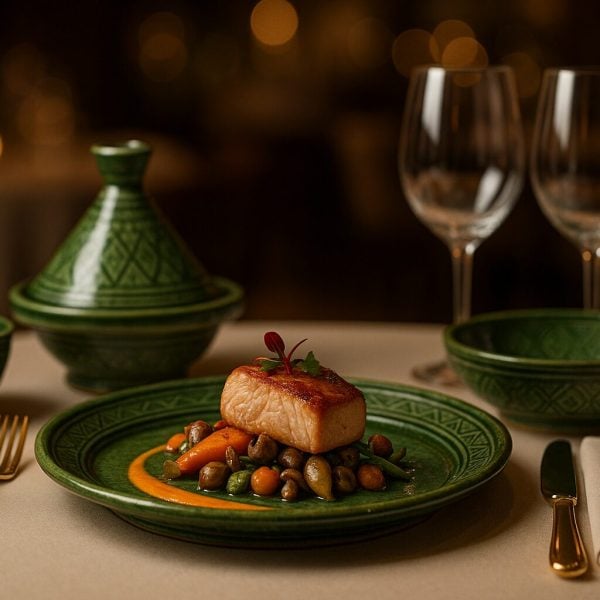
This is the most important practical question to get right before purchasing, and the answer depends entirely on how the piece was made. Decorative Moroccan pottery — the brightly colored, heavily glazed bowls and tagines sold in tourist markets — frequently uses lead and cadmium-based glazes to achieve bold colors and high gloss. These pieces are display-only and should never be used for food or drink. Food-grade Moroccan ceramics, including traditional unglazed cooking tagines and properly formulated beldi ware, are made without toxic glazes and are safe for food contact. Always check that a piece is labeled food-safe or lead-free before use as tableware. Our ceramic plates and bowls are all clearly labeled for intended use, and for a deeper look at what makes ceramics commercially viable for food service, see our guide on Moroccan ceramic restaurant tableware.
How to Style Moroccan Pottery at Home
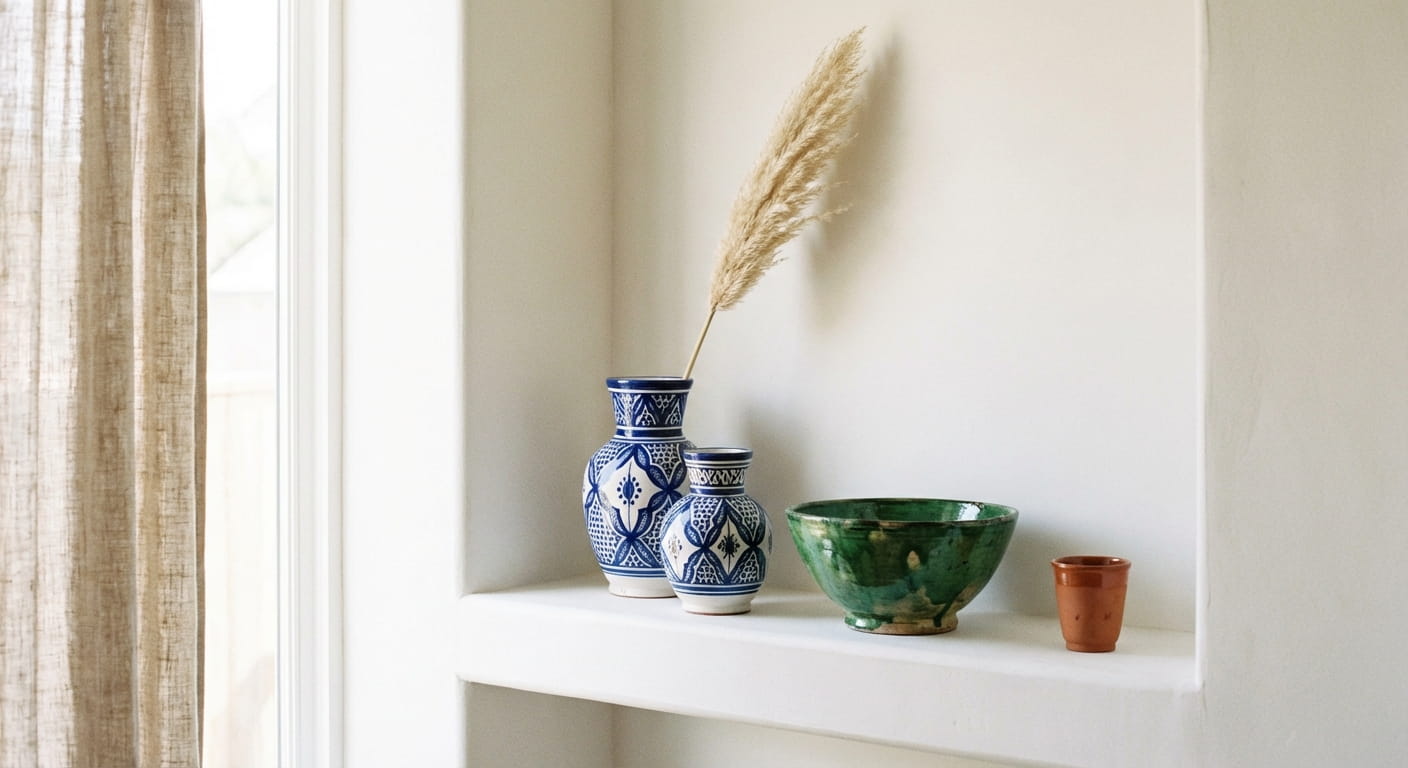
Moroccan pottery works in contemporary interiors precisely because it doesn’t try to match — it contrasts. A Tamegroute green bowl on a pale marble countertop. A cluster of Fassi blue vases against a whitewashed wall. A rustic beldi serving plate at the center of a modern linen-dressed dining table. The principle in all cases is the same: group by color family, mix scales, and let the hand-made quality read as collected over time rather than purchased as a set. For detailed room-by-room placement ideas, our guide on styling Moroccan pottery bowls in small spaces covers what works even in compact apartments.
Browse our full Moroccan ceramics collection — sourced directly from artisan workshops in Fez, Safi, and Marrakech, with free worldwide shipping on all orders.
Frequently Asked Questions
The main types of Moroccan pottery are tagines (conical-lidded cooking and serving vessels), beldi bowls and plates (everyday tableware in earthy tones), decorative vases and vessels, and zellij tiles (architectural mosaic work). Regionally, the three most distinct styles are Fassi blue from Fez, multicolor metalwork-inlaid pieces from Safi, and the distinctive flowing green-glazed ware from Tamegroute in southern Morocco.
Moroccan pottery is called khzaf in Darija (Moroccan Arabic). Regional styles have their own names: Fez’s blue-and-white ceramics are called Fassi pottery or khzaf fassi, Tamegroute’s green-glazed ware is khzaf akhdar (green pottery), and the hand-chiseled mosaic tiles are zellij. Rustic hand-thrown tableware sold in souks is commonly called beldi ware — meaning traditional or authentic.
Not all Moroccan pottery is food safe. Decorative ceramics — the brightly glazed pieces sold in tourist souks — often use lead and cadmium-based glazes that are unsafe for food contact. Unglazed cooking tagines and specifically labeled food-grade beldi ware are safe. Always check for a “food safe” or “lead-free glaze” label before using any piece as tableware. When in doubt, treat the piece as decorative only.
Fez pottery is double-fired and painted in cobalt blue with precise arabesque patterns on a white tin-glaze base — formal, classic, highly refined. Safi pottery uses mineral-rich red clay with a wide color palette and a unique metal-inlay technique — bolder, more eclectic. Tamegroute pottery is characterized by a single flowing copper-and-manganese green glaze with natural variation in each piece — organic, minimal, unlike anything produced elsewhere in Morocco.
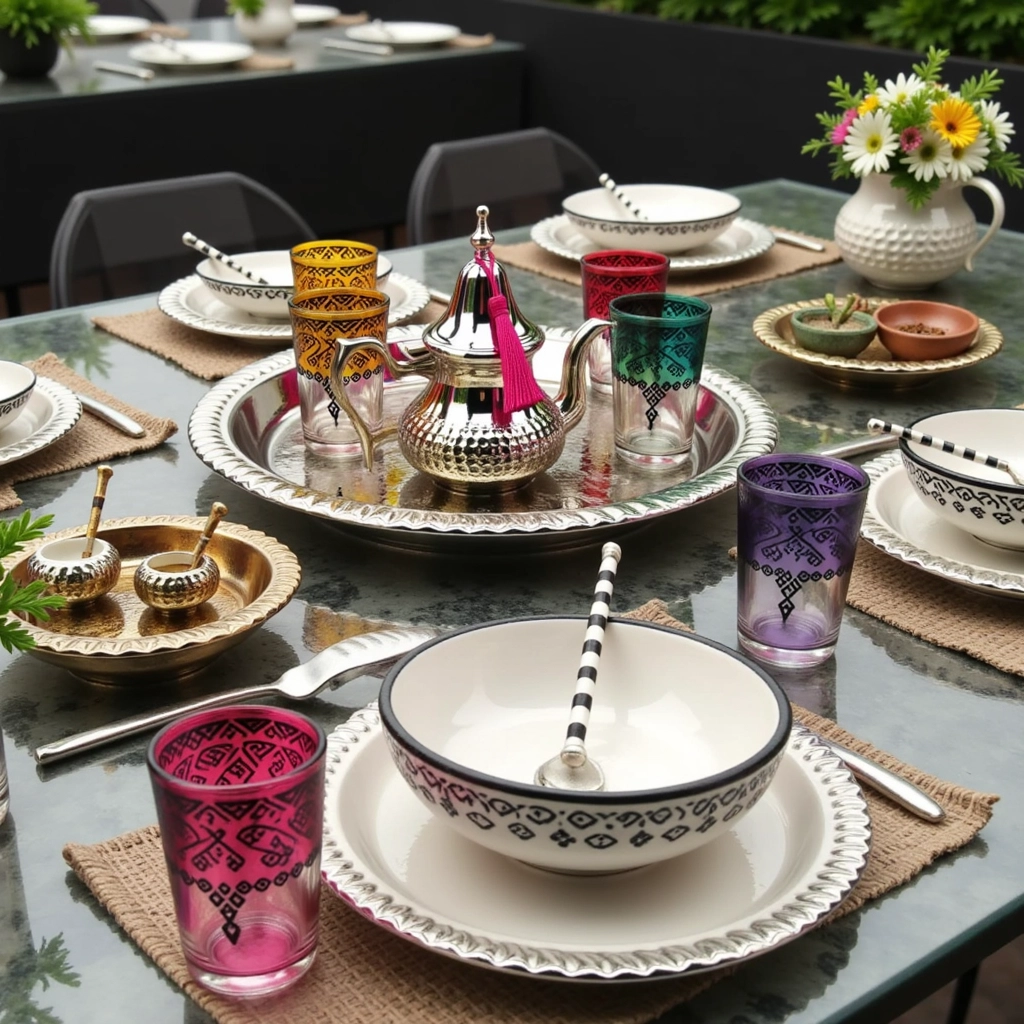
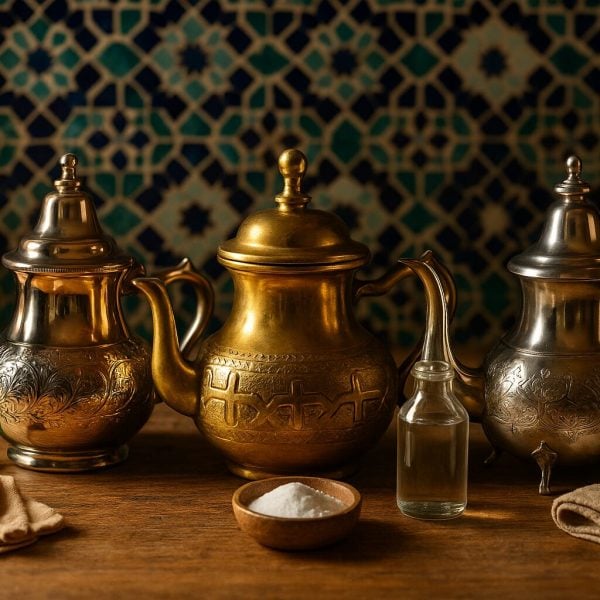
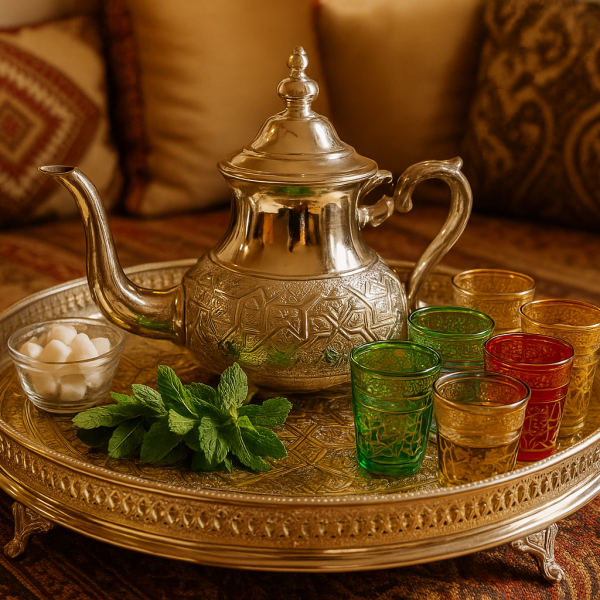
Moroccan ceramics work best in clusters — mix bowl sizes and pair with a Moroccan tea set on the table and pillow covers in complementary colours on the sofa. The result is a layered, intentional interior that reads as authentically Moroccan rather than decorative souvenir.
Hand-wash glazed Moroccan pottery with warm water and mild dish soap — never machine wash, as the thermal shock of dishwashers can crack glazed surfaces and fade painted decoration. For unglazed cooking tagines, avoid soap entirely; rinse with warm water and dry thoroughly. For light calcium deposits, a diluted white vinegar rinse works well. Store away from direct sunlight to prevent long-term color fading in pieces with natural mineral pigments.
Moroccan pottery refers to three-dimensional ceramic objects — bowls, vases, tagines, vessels. Zellige is a form of architectural mosaic tilework made from the same ceramic base, but cut by hand into small geometric shapes and assembled into flat panels used on floors, walls, and fountains. A maalem (zellige master) and a potter are entirely separate craft specializations, though both originate in the same centuries-old Moroccan ceramic tradition centered in Fez.