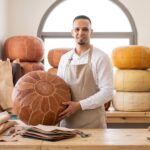
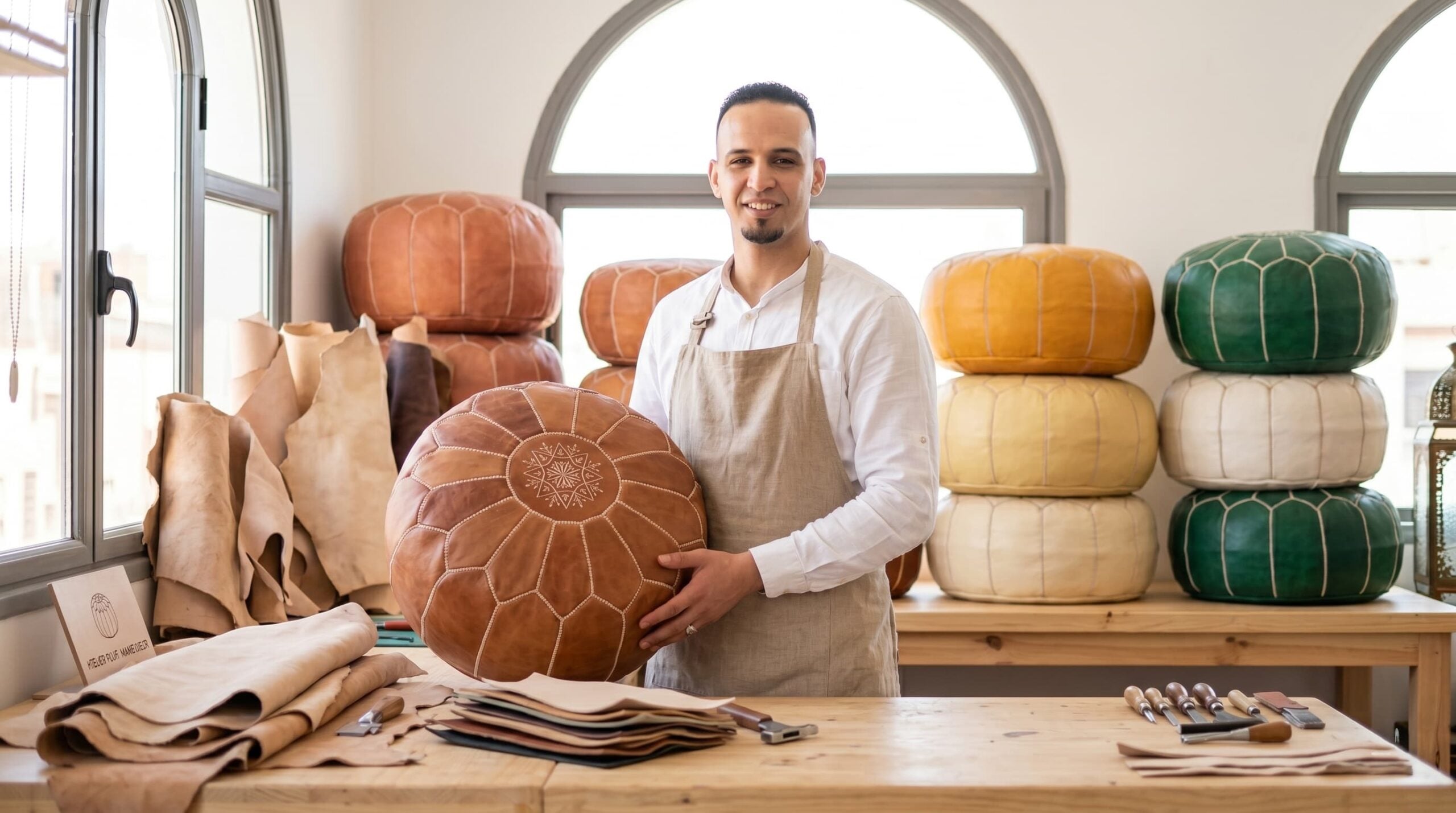
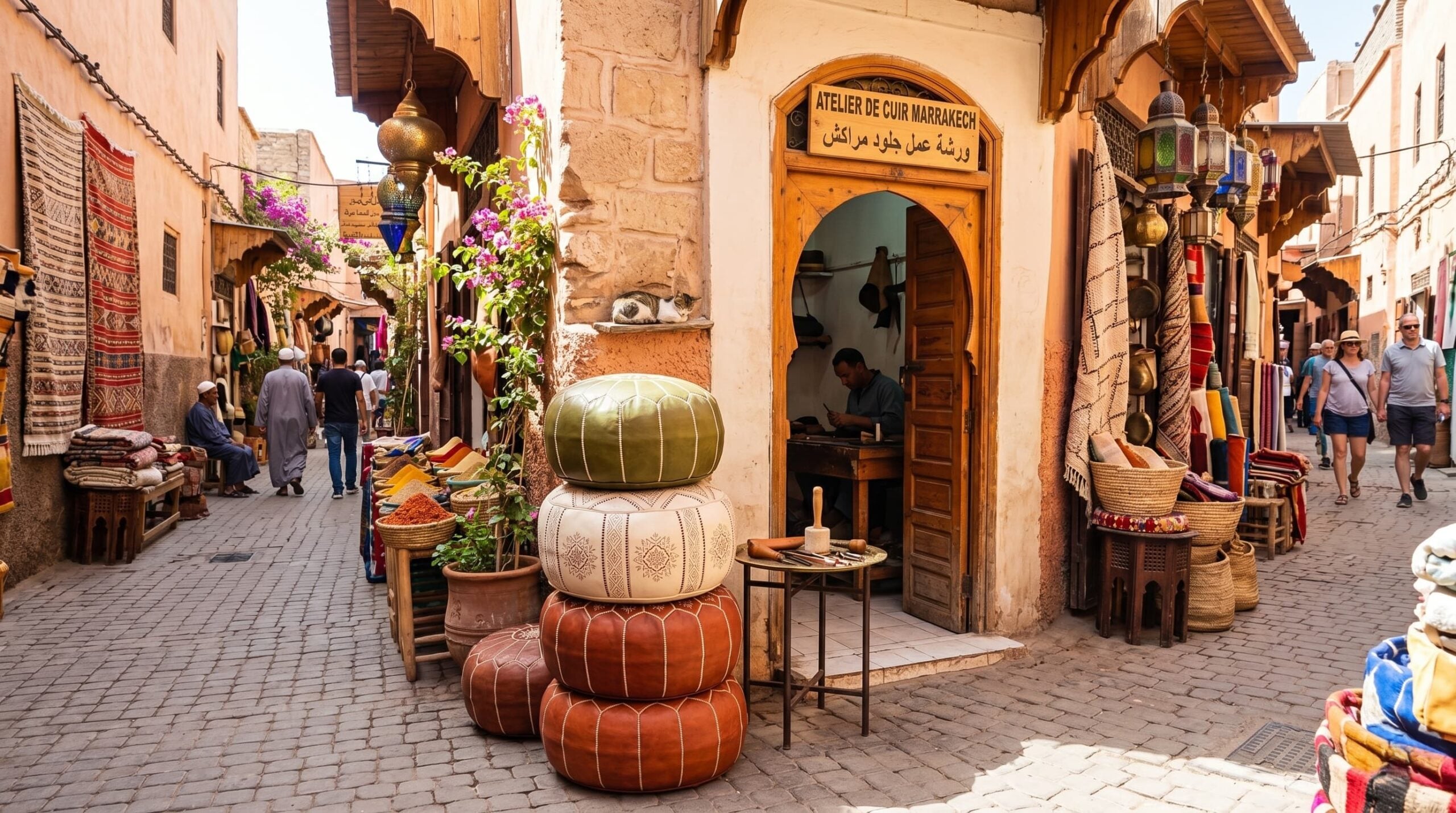
The leather souk near Souk Tala’a doesn’t announce itself — it draws you in. First the smell: rich, earthy, alive. Then the colour: burgundy, saffron, ivory hides hanging in doorways like flags of a craft older than the medina walls. And somewhere inside that labyrinth, Abdelilah has been at his bench for sixteen years, shaping goatskin into something a home in New York or London will revolve around.
He is 38. He has never needed a storefront sign.
“The poufs speak for themselves. Anyone who knows leather stops when they see mine.” — Abdelilah, leather pouf artisan, Marrakech
1. A Craft Learned, Not Chosen — Then Chosen Every Day
Abdelilah didn’t stumble into leatherwork. He was apprenticed to a master craftsman in the leather souk as a young man, handed the most basic tasks first — holding, watching, learning the patience that the craft demands before it ever demands skill. In Morocco’s traditional maallem (master-apprentice) system, you earn your tools slowly. You don’t rush a hide, and you don’t rush an artisan.
Sixteen years later, Abdelilah runs his own workshop near Souk Tala’a, with several craftspeople working alongside him. The bench looks different now — his own, earned — but the principles his master taught him remain unchanged: measure twice, cut once, and never compromise on the leather.
2. From Dar E-Dbagh to the Workbench: The Journey of a Hide
Every handmade leather pouf from Abdelilah’s workshop begins the same way: a goatskin arriving from Dar E-Dbagh — the tannery quarter of Marrakech, where hides have been treated in terracotta pits since the medieval period.
The tanning itself is a separate, ancient craft. By the time a skin reaches Abdelilah, it has already been through lime baths, natural softening agents, and days of drying under the Moroccan sun. What arrives at his bench is a clean, supple hide ready to become something.
What happens next is his.
The process, step by step:
- Hand-dyeing — Each hide is dyed by hand to the customer’s chosen colour. No two batches are identical; slight tonal variations are the mark of authentic craftsmanship, not a quality flaw.
- Inner lining — A fabric lining is fitted inside, giving the pouf its structure and protecting the leather from the inside out.
- Pattern cutting — The hide is cut precisely according to the pouf type — round or square — with no room for error on expensive goatskin.
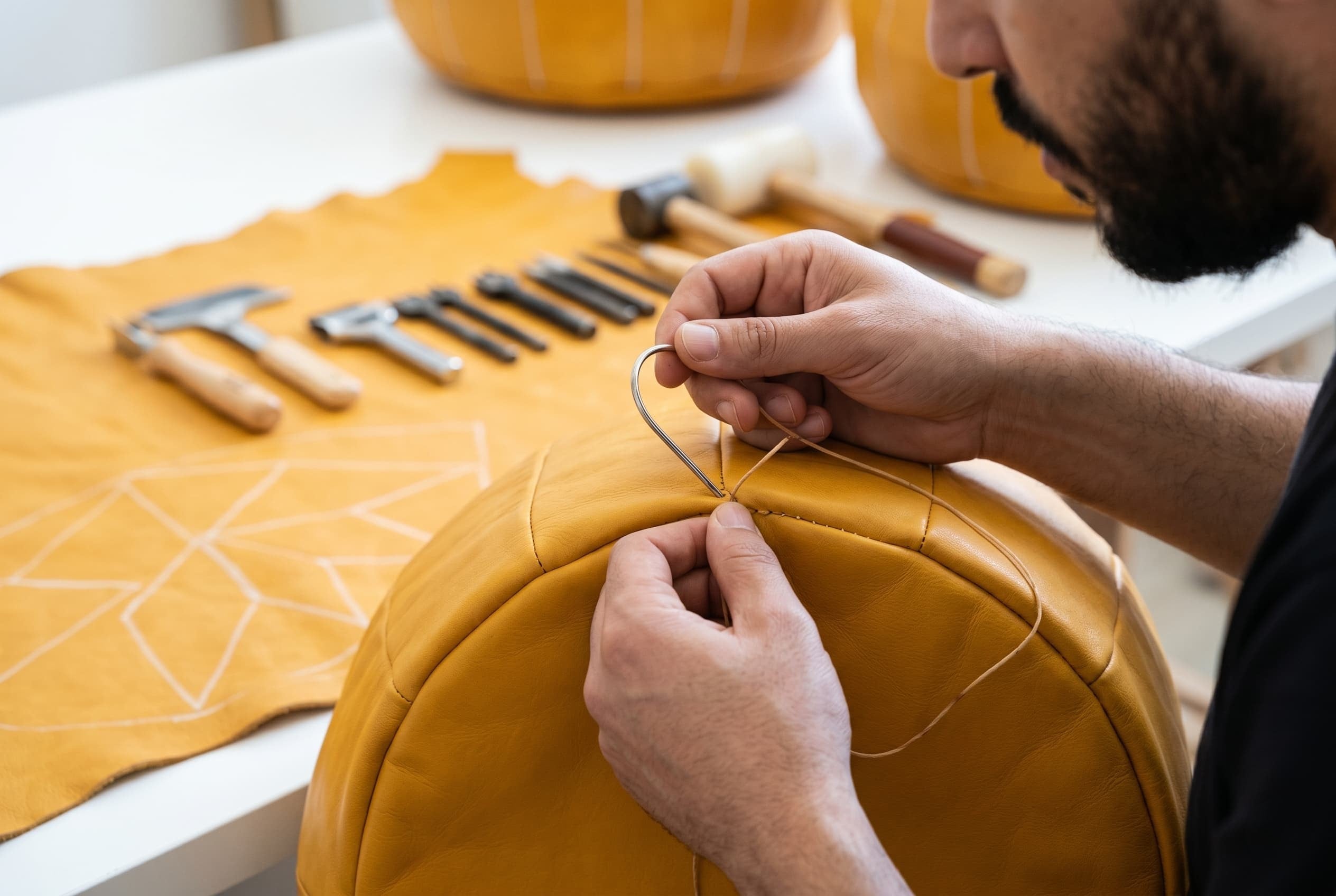
- Hand-stitching — The panels are sewn together by hand. This is where the durability lives: tight, even stitching that holds under years of daily use.
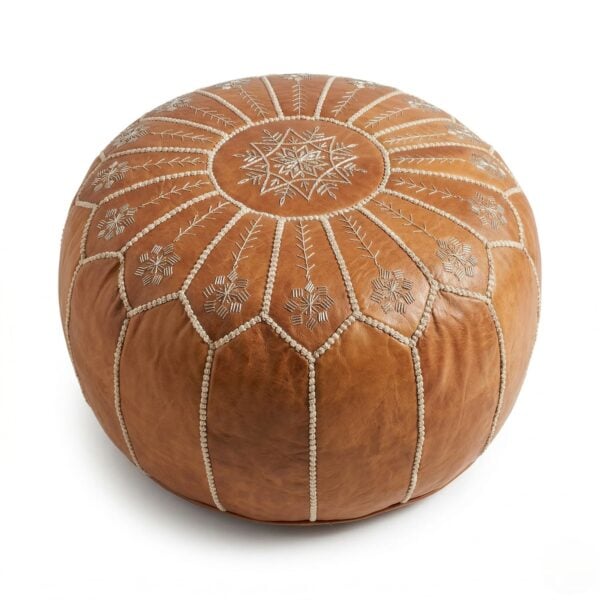
- Embroidery — The decorative work is handled by experienced women artisans, each embroidered pattern requiring its own steady rhythm and skill.
From raw hide to finished leather pouf, the process takes between 5 and 10 days. There is no faster way to do it well.
3. The Problem No Craft School Teaches: Getting Found
Abdelilah is exceptional at making poufs. He is, by his own admission, less equipped for the business of selling them.
When he opened his own workshop and began producing under his own name, the craft was ready. The market wasn’t — or rather, the market didn’t know he existed. His poufs sat in the souk, admired by passersby, occasionally purchased by a tourist with a good eye. But the global demand for quality Moroccan leather goods — the customers in the United States, in Europe, in Australia, who were actively searching for exactly what he made — had no way to reach him, and he had no way to reach them.
It’s a gap that swallows talented artisans quietly. Not for lack of skill. For lack of a door.
4. A Walk Through the Leather Market, and a Partnership
Mohamed, founder of Marrakeche Crafts, spends time in the souks the way other founders spend time reading market reports — walking, looking, asking. He wasn’t searching for Abdelilah specifically. He was looking for what the souk always offers to anyone paying proper attention: work that’s genuinely better than average.
He found it in a stack of poufs. The stitching was too precise, the dye too even, the shape too well-considered to be the work of someone going through the motions. He asked about the shop. Someone pointed him toward Abdelilah.
Over tea, Mohamed explained the model: Marrakeche Crafts handles the photography, the shipping logistics, the international storefront. The artisan does what the artisan does best. Abdelilah — who had spent years producing exceptional work for a market too small to hold it — agreed.
5. The Work Continues. Now the World Sees It.
Nothing changed about how Abdelilah works. The same goatskin from the same tanneries. The same hand-dyeing, the same careful cutting, the same team stitching panels together with unhurried precision. The same women whose embroidery hands have been moving in the same patterns for years.
What changed is who receives the work when it’s done.
A pouf that once had to wait in a souk doorway for the right visitor now ships to living rooms across the United States and Europe, styled into interiors its maker will never see — but whose owners know exactly who made it, and how, and where.
That traceability matters. It is, in fact, the whole point.


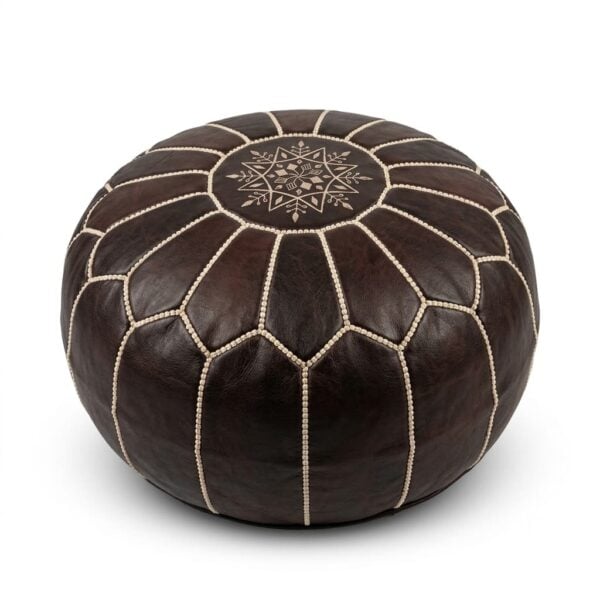

 Multicolor
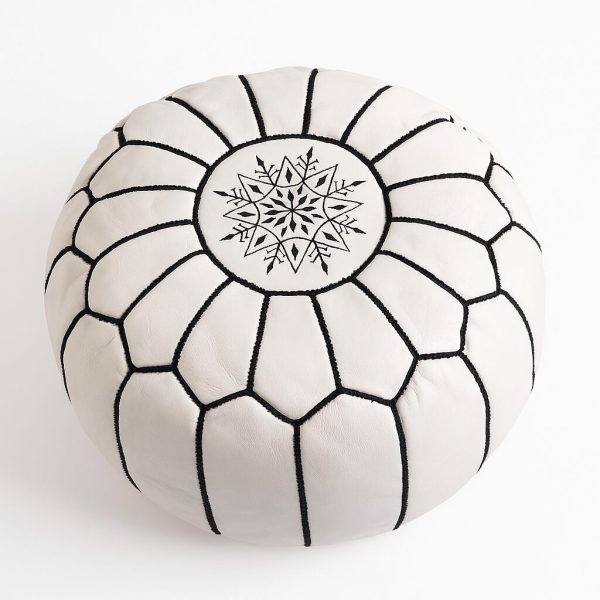


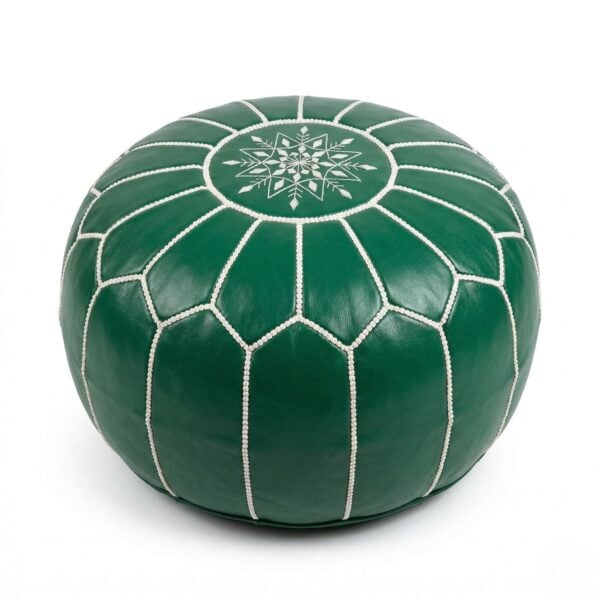
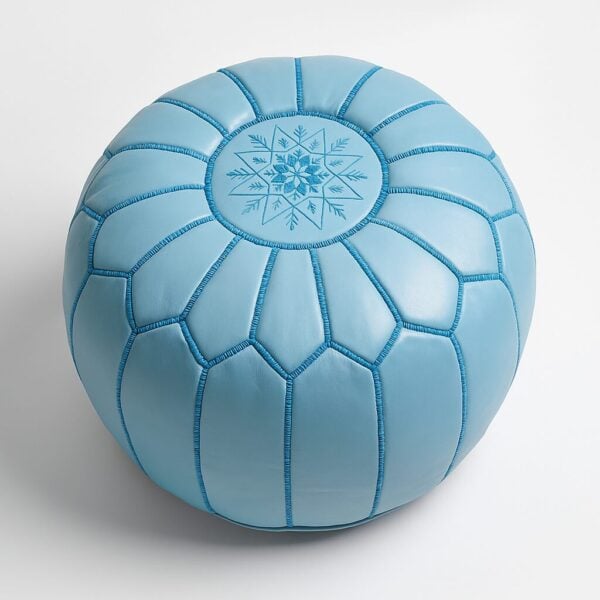




6. What a Handmade Leather Pouf Actually Is
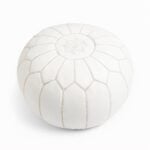
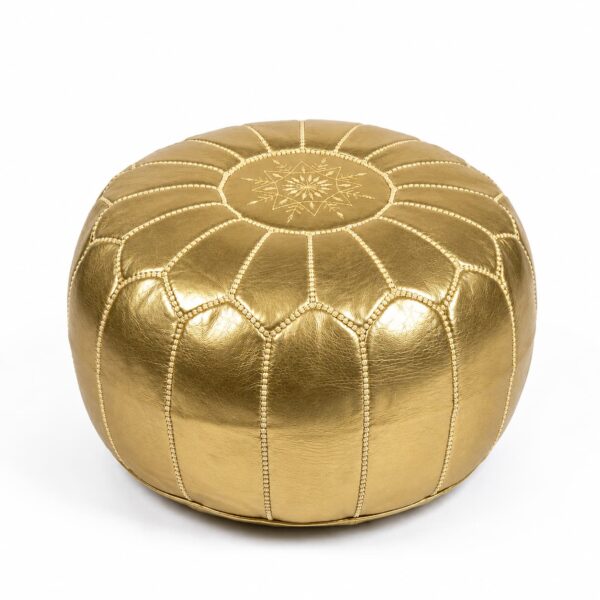
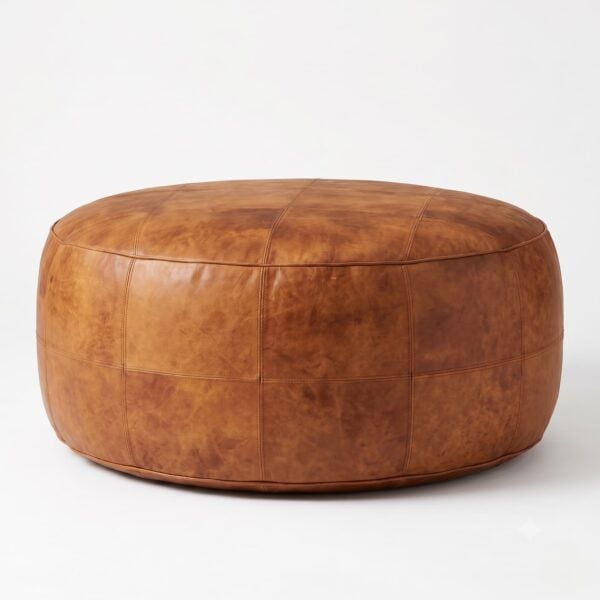
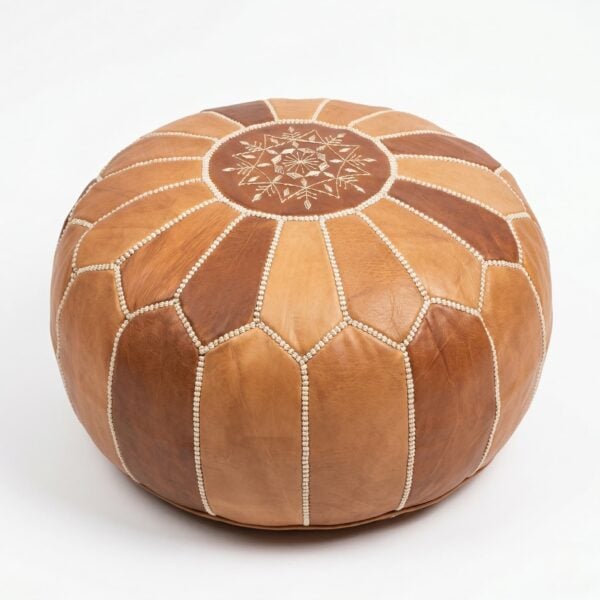
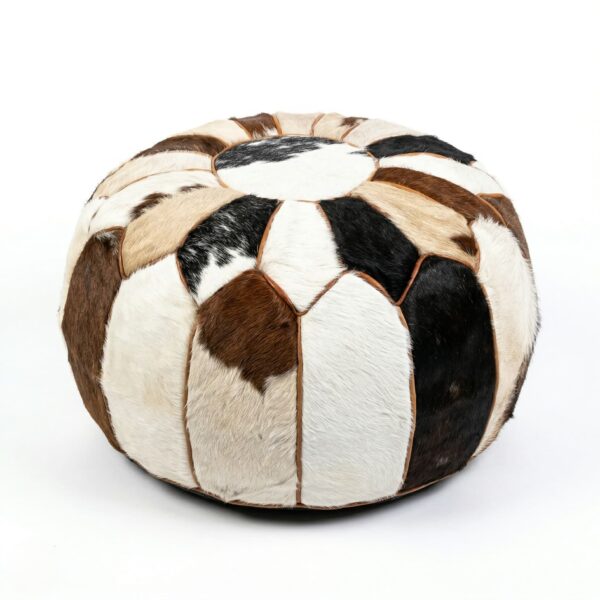
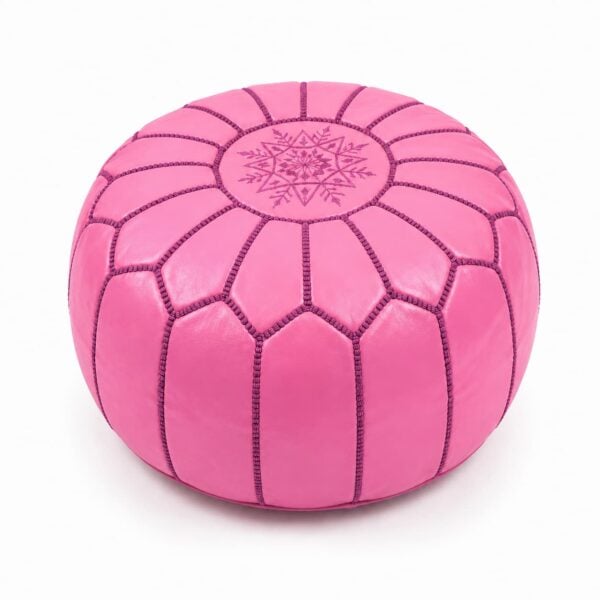
For anyone outside the medina, a Moroccan leather pouf can look like a simple floor cushion. It isn’t. It is a compressed record of decisions: the tannery that prepared the hide, the craftsman who chose the dye, the women who executed the embroidery, the hands that stitched it closed.
Abdelilah has made hundreds of them. He could make them faster, with machine-cut panels and pre-dyed stock leather. He doesn’t. Not because he’s sentimental about the old way — but because the old way produces a better pouf, and he knows the difference.
So, eventually, does everyone who sits one in their home.
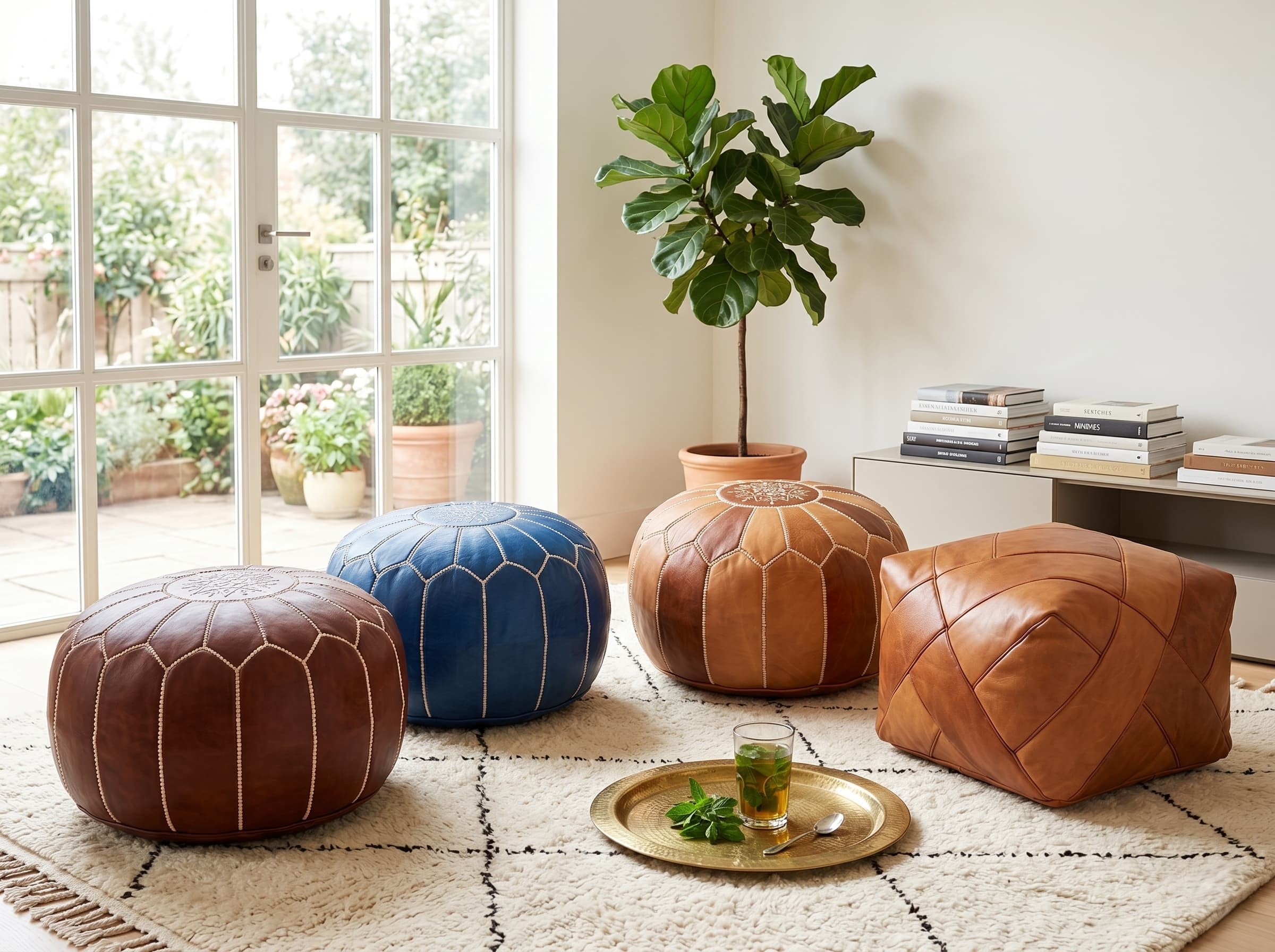
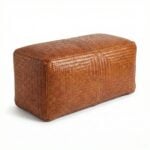
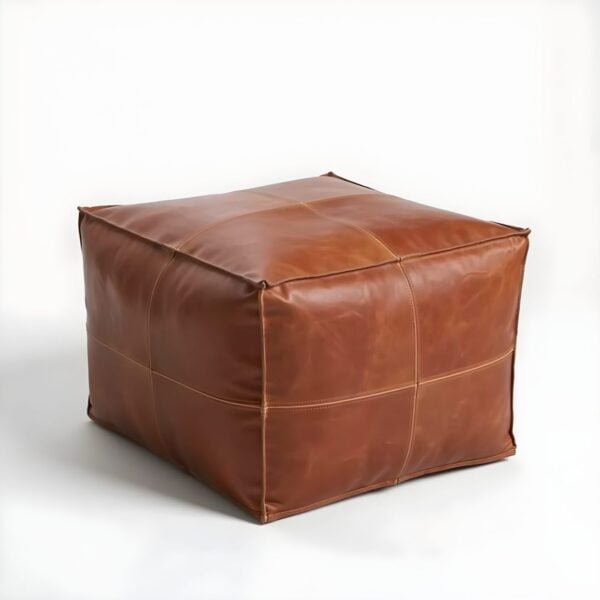
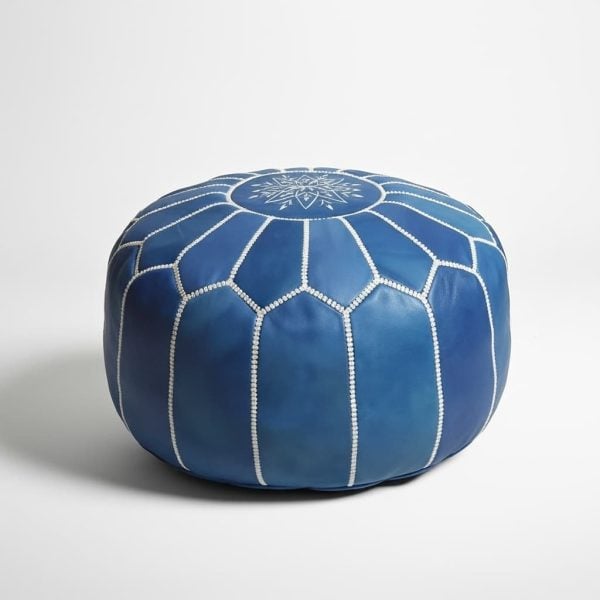
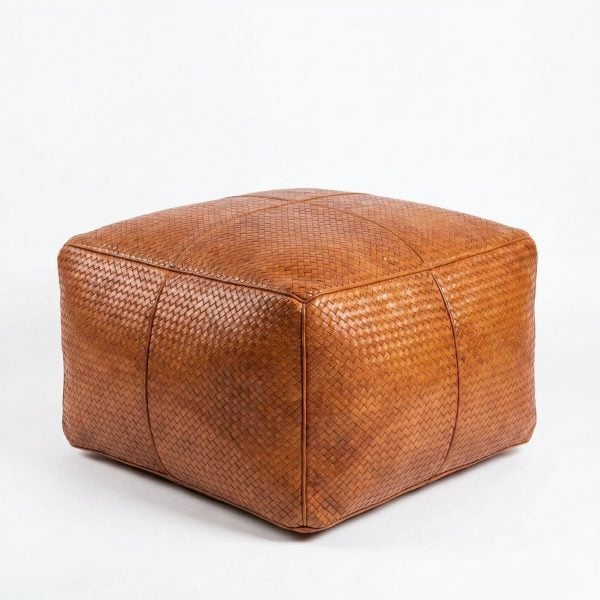
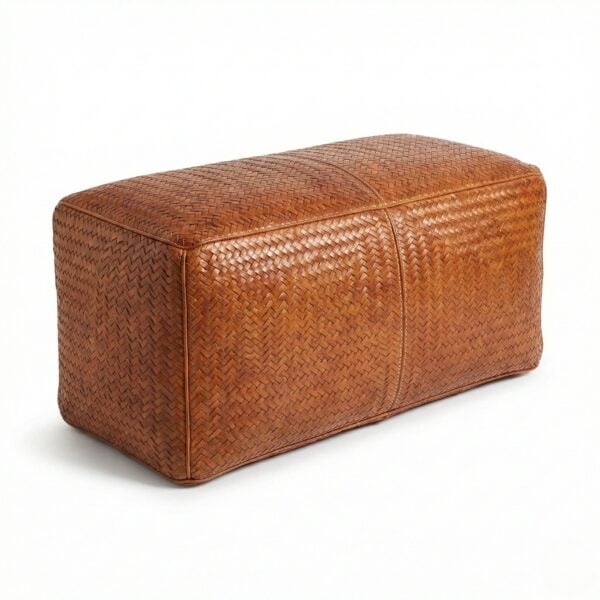
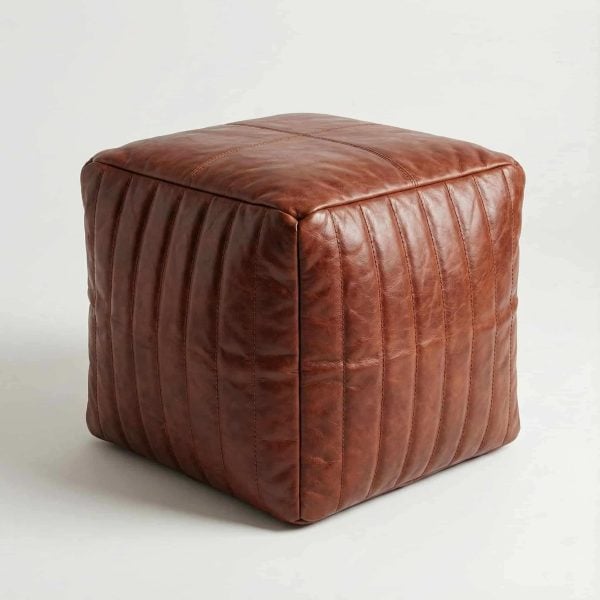
Discover Abdelilah’s handmade leather poufs — available in round and square, in a range of hand-dyed colours, with free worldwide shipping. → Shop Leather Poufs → Round Leather Poufs → Square Leather Poufs
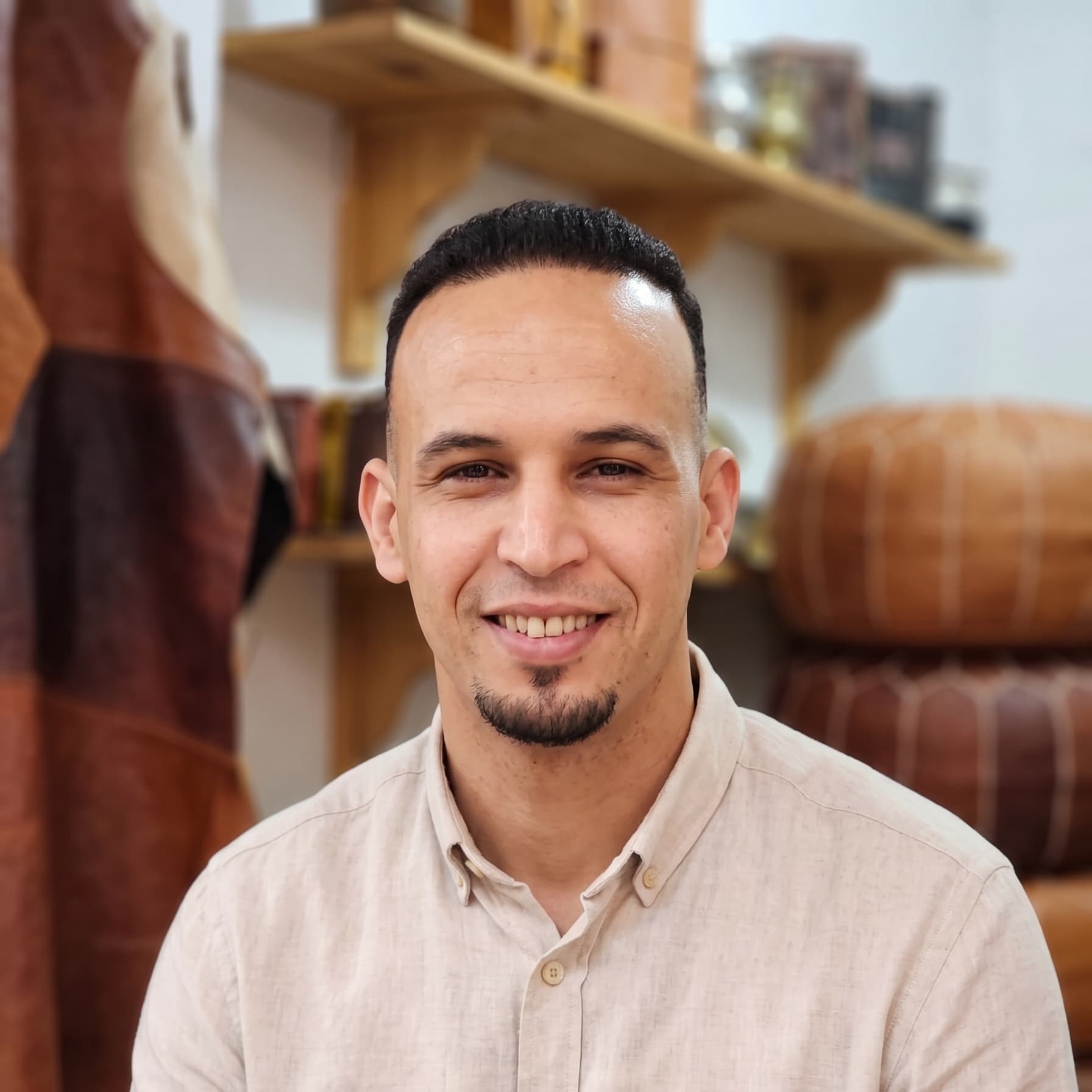
Abdelilah
Leather Pouf Artisan, Marrakech
- Craft: Hand-cutting, hand-dyeing, and hand-stitching leather poufs
- Location: Leather Souk, near Souk Tala’a, Marrakech, Morocco
- Experience: 16 years
- Primary material: Goatskin — sourced from Dar E-Dbagh tanneries, Marrakech
- Technique: Hand-dyeing to order, hand-cutting panels, hand-stitching, with embroidery completed by experienced women artisans
- Production time: 5 to 10 days per pouf
- Products: Leather poufs (round and square)